
The Responsible Owner’s Guide to Firearm Safety and Secure Home Storage
The Responsible Owner’s Guide to Firearm Safety and Secure Home Storage
At Custom Firearms, we believe that the right to keep and bear arms comes with a profound personal responsibility. Whether you just purchased your very first handgun for personal protection or you are a seasoned collector adding a new rifle or suppressor to your vault, maintaining a strict safety protocol is paramount.
True security doesn’t stop when you lock your front door; it begins with how you handle and store your firearms inside your home.
Whether you are welcoming guests, managing a busy household, or simply securing your property against unauthorized access, this guide covers the core pillars of safe handling and secure storage every responsible owner should live by.
1. The Four Golden Rules of Firearm Safety
No matter how experienced you are, safety lapses happen when complacency sets in. Every single time you interact with a firearm, these four foundational rules must be followed without exception:
-
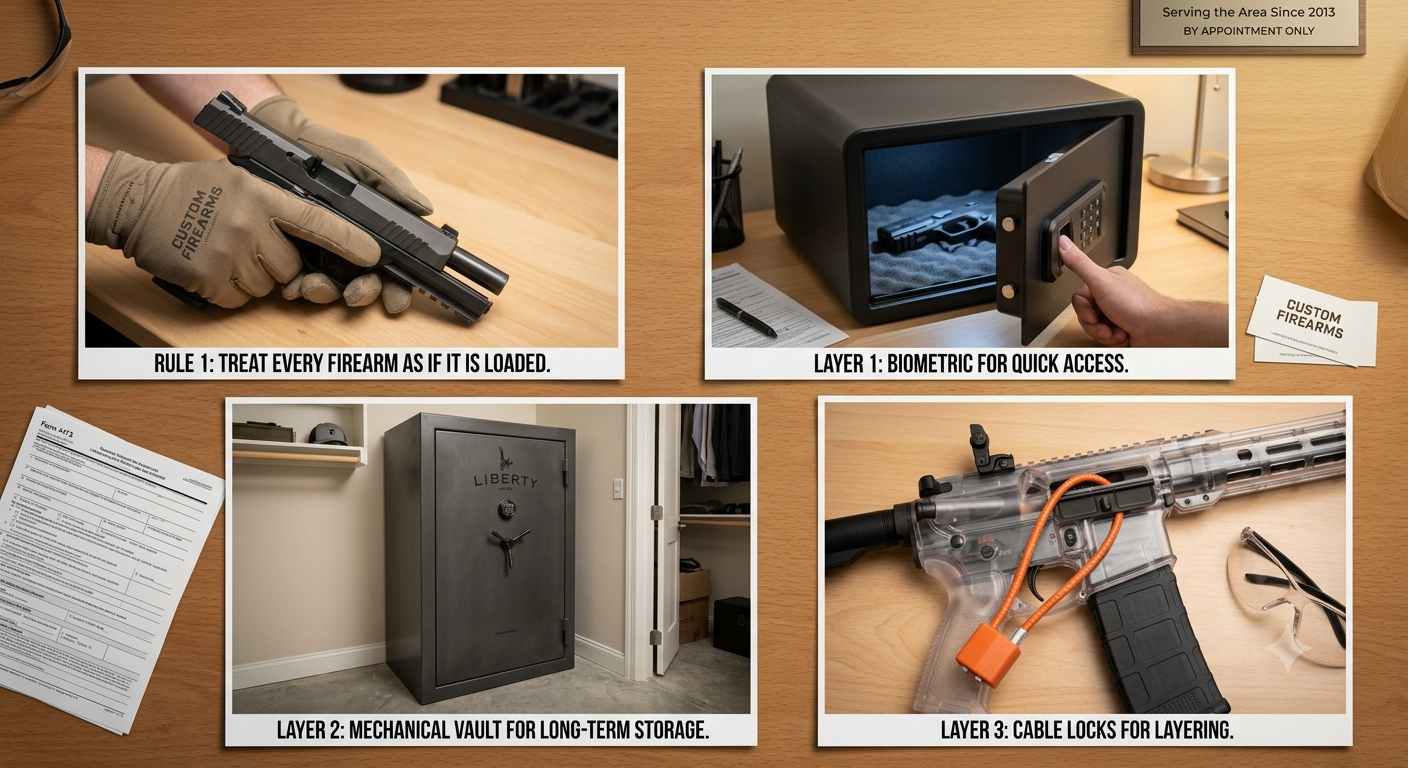
Treat every firearm as if it is loaded. Never assume a gun is clear just because someone else told you it is, or because you remember unloading it. Check it visually and physically every single time you pick it up.
-
Never point a firearm at anything you are not willing to destroy. Always maintain absolute control over the direction of the muzzle. Keeping it pointed in a safe direction ensures that an accidental discharge will not result in injury or property damage.
-
Keep your finger off the trigger until your sights are on the target. Your finger should rest naturally along the frame or receiver of the firearm until you have made the conscious decision to shoot.
-
Be sure of your target and what is beyond it. In a home environment, bullets can easily penetrate drywall, doors, and furniture. Always be intensely aware of your backstop and your surroundings.
2. Secure Home Storage Solutions: Finding the Right Balance
When deciding how to store your firearms at home, your strategy should balance two critical factors: preventing unauthorized access and maintaining defensive accessibility if needed.
Depending on your household dynamic, here are the most effective secure storage options available today:
🔒 Quick-Access Biometric Safes (Best for Home Defense)
If you keep a handgun ready for personal protection, leaving it loose on a nightstand or hidden in a drawer is a massive safety risk—especially if children or visitors enter your home. A quick-access biometric or electronic keypad safe allows you to keep a firearm loaded and secure from unauthorized hands, while still giving you access to it in seconds via a fingerprint or a simple code.
🔒 Heavy-Duty Mechanical Safes (Best for Large Collections)
For long guns, hunting rifles, NFA items, and items you do not use on a daily basis, a heavy-duty, fire-rated gun safe is the gold standard. These safes secure your investments against theft and natural disasters.
-
Pro-Tip: Always bolt your large safe directly to the floor or wall studs. A determined burglar can easily wheel a top-heavy safe out of a house if it isn’t anchored down.
🔒 Cable and Trigger Locks (Best for Layered Transport or Storage)
Most new firearms ship with a heavy-duty cable lock. Running a cable through the open action of a semi-automatic handgun or a long gun completely prevents the firearm from cycling or firing. While not a substitute for a safe against a thief with power tools, it is an excellent layer of safety when traveling or cleaning your gear.
3. Integrating Safety in a Multi-Person Household
If you share a home with family, roommates, or children, your storage rules must adapt.
-
The Staged Ammo Rule: A time-tested security practice is to store your firearms and your ammunition in separate locked locations whenever possible. If an unauthorized individual somehow manages to access a locked case, separating the ammunition breaks the chain of potential danger.
-
The “Zero Accidental Discovery” Principle: Never rely on “hiding spots.” Children are natural explorers, and guests can easily stumble upon an improperly stored firearm in a closet, high shelf, or vehicle glove box. If a firearm is not physically on your person, it belongs locked in a secure container.
-
Education Beats Ignorance: Demystifying firearms reduces curiosity. If you have children, teaching them exactly what to do if they ever see an unattended firearm (“Stop. Don’t touch. Leave the area. Tell an adult.”) is just as important as locking up your equipment.
The Home Storage Checklist
Before you turn off the lights tonight, make sure your setup checks all of these responsible ownership boxes:
-
[ ] Are all defensive firearms secured in quick-access lockboxes?
-
[ ] Are long guns and bulk ammunition locked in a heavy-duty vault?
-
[ ] Is your primary safe securely anchored to prevent removal?
-
[ ] Have you verified that your current household address matches your government-issued ID for any future transfers?
-
[ ] Are your high-value NFA items properly cataloged in a safe or a dedicated Gun Trust to ensure your heirs are legally protected?
We’re Here to Support Your Journey
Responsible ownership is a lifelong commitment, and you don’t have to navigate it alone. At Custom Firearms, we aren’t a loud, high-traffic retail storefront trying to hit a sales quota. We are a trusted, local, home-based FFL provider operating strictly by appointment.
We take pride in providing a quiet, private, one-on-one environment where you can comfortably complete your online firearm transfers, receive dedicated guidance on your paperwork, and explore specialized local NFA and suppressor services with absolute peace of mind.

Add comment